
Propaganda is the biggest challenge to peaceful coexistence
Colin Alexander
The anti-war novelist Erich Maria Remarque wrote in The Way Back (1931) that, “Maybe that is the reason why there are always wars, because you can never truly share the suffering of other people.”
I’m a big fan of Remarque’s work. It is philosophy thinly veiled as a novel. Likewise, I think many of the other anti-war novelists and poets of the 1920s and 1930s continue to be profoundly relevant within the current climate of broad public acceptance of war in their names.
Without a pan-European armed conflict for over eighty years, war has moved into the realm of, what memory studies academics call, ‘cultural memory’. A situation where very few people in the West now have direct experience of living under the threat of bombardment and total annihilation at home.
The lack of people like Remarque in our society – who experienced and suffered the horrors of war – makes it a concept ripe for propagation into a glorious and splendid idea, rather than a ghastly and barbaric act that should be prevented at all costs and made illegal.
On this point, I turn to the start of Tony Benn’s speech in the House of Commons in March 2003 as he opposed the invasion of Iraq.
“War is an easy thing to talk about. There are not many people of the generation that remember it. The Right Honourable Gentleman (pointing to Ted Heath across the chamber) served with distinction. I never killed anyone but I wore a uniform. I was in London in the Blitz in 1940… and it was terrifying.”
I want to take issue with several parts of the initial quotation from Remarque though. First, there haven’t always been wars. Wars are a relatively recent phenomenon in 250,000 thousand years of human history, and it is only in the last several thousand years that their propensity, intensity, acceptability and even normalisation as part of the human experience have increased. In short, with the conquest of the natural world, humans have increasingly turned to the conquest of each other.
The widespread acceptance and normalisation of the barbaric occurs through propaganda. Highly persuasive doctrines, texts and media content – alongside a communications strategy that seeks to elevate some narratives and marginalise inconvenient others – that seeks to diminish war’s grotesqueness and terror and to highlight its, sometime divine, glory.
Thus, propaganda – defined by Harold Lasswell in 1928 as “the management of collective attitudes by the manipulation of significant symbols” – is just not an additional part of war. It is almost the entire reason that we have wars at all. For, if people were better able to understand their own minds and emotions, they would likely reject the encouragement of mass violence.
Thus, while Remarque is right that we cannot truly understand other people’s experiences and emotional states, the propaganda of the industrial age – focused towards the self-interest of powerful actors and encouraging individualism, factionalism, self-doubt and the weakening of the collective – has discouraged and devalued the pursuit of that understanding. We live in a disconnected time, where emotional wellbeing has been commercialised and social media’s offer represents a false consciousness that it can adequately compensate for the loss of intimacy.
Under these circumstances, the rekindling of an authentic life, and the will to feel deeply the pain and anguish of sometimes distant others, would serve the ambition of world peace well as it would offer at least a partial reconnection to the original state of man as a social, kind and collective species.
Such a reality is a far cry from the argument of Adam Smith in The Wealth of Nations (1776) when he misanthropically claimed that benevolence and a collective conscience were human weaknesses. “In almost every other race of animals, each individual, when it is grown up to maturity, is entirely independent, and in its natural state has occasion for the assistance of no other living creature. But man has almost constant occasion for the help of his brethren, and it is in vain for him to expect it from their benevolence only.”
He is also wrong about other species. Many of whom rely on group living to flourish.
To this end, let me say something very basic, but important. Human beings are mostly very nice and enjoy being funny, happy, loving, connected and helpful. They don’t like violence and they worry about having violence committed upon them or their families. They find violent, or potentially violent and aggressive situations highly stressful. Violence is completely at odds with most conceptualisations of what human flourishing means and those attracted to violence have often grown up in dysfunctional conditions.
The horror of war and its derogatory effects upon the human mind have been well documented in psychology literature and are consistently depicted in literature. For example, in Lewis Grassic Gibbon’s famous novel Sunset Song (1932) there is the character Ewan Tavendale who is a good husband and father, but who then enlists to fight in the First World War and comes home a different character enacting great brutality upon his wife.
Juxtaposing this is the work of those who try to encourage military service and publics to accept war in their name, or, at the very least, do not fully relay the horror of what they witness and thus are complicit by their self-censorship. This includes the publications of many war reporters that have – through selectivity of word and image – sanitised the immorality and grotesqueness of its brutal occurrence by not displaying its true horror.
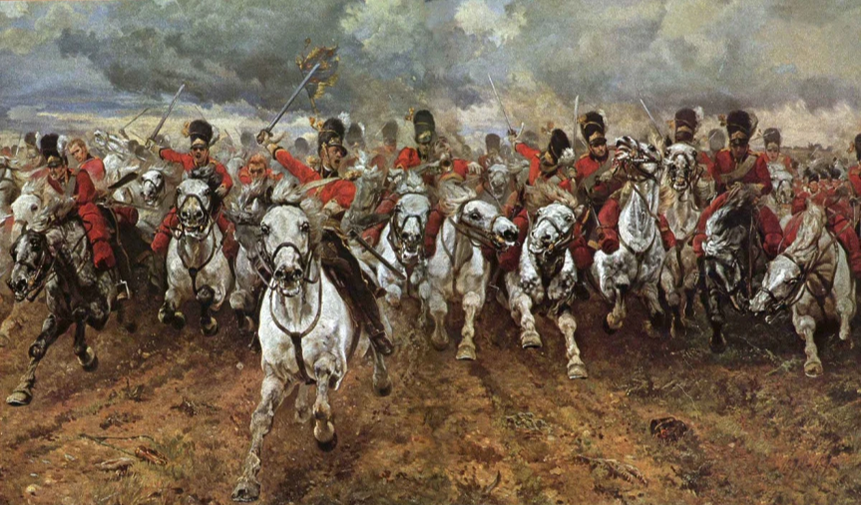
Indeed, the work of the first widely recognised war correspondent for The Times, William Howard Russell, provides a considerable case in point. Here is an extract from his Charge of the Light Brigade correspondence from 1854.
“If the exhibition of the most brilliant valour, of the excess of courage, and of a daring which would have reflected lustre on the best days of chivalry can afford full consolation for the disaster of today, we can have no reason to regret the melancholy loss which we sustained in a contest with a savage and barbarian enemy.”
“They swept proudly past, glittering in the morning sun in all the pride and splendour of war. We could hardly believe the evidence of our senses. Surely that handful of men were not going to charge an army in position? Alas! It was but too true — their desperate valour knew no bounds, and far indeed was it removed from its so-called better part — discretion.”
The fate of those British soldiers involved in The Charge is well-known, and such ‘journalism’ was likely an effort to deflect from the gross incompetency of those events and to distract the public by images of a subhuman enemy.
Most contemporary war reporting does not address the subject in the ‘flowery’ way Russell did. However, it remains highly selective in its coverage (using simple storytelling of goodies and baddies) and is almost always at the very least a “journalism of attachment” (to use Martin Bell’s phrase) for one side or another.
Ultimately, the depressing reality is that, time and again, the purpose of the vast majority of public communications concerning war limits the public’s consciousness, conscience and sense of what is realistically possible to a position short of full revulsion towards armed combat. At best, war becomes viewed as something unfortunately necessary. Nevertheless, Smedley Butler (1935) famously argued that ‘war is a racket’ and part of the racketeering here involves the use and creation of intellectual convictions, moral valuations, and emotional preferences in support of powerful interests seeking to dilute an ultimatum for peaceful coexistence.
Moreover, propaganda, or, more accurately, that only a small minority of the public are able identify and then fully critically appraise and deconstruct a piece of propaganda, its intentions and its origins (what is sometimes known as ‘media literacy’) represents the most significant hurdle to the diminishing of war as a legitimate instrument of national policy.
Dr Colin Alexander is a Senior Lecturer in Political Communications at Nottingham Trent University. You can follow his work on tiktok @propagandaexpert